
Delve into the world of Solo 401k Strategies for Self-Employed Investors with this insightful guide that offers a wealth of knowledge on maximizing retirement savings and optimizing tax benefits. The following paragraphs will provide a detailed exploration of the key aspects surrounding Solo 401k plans, shedding light on investment options, contribution strategies, tax planning, and more.
Explore the nuances of Solo 401k Strategies for Self-Employed Investors as we navigate through the intricacies of retirement planning tailored to individual entrepreneurs and freelancers.
Overview of Solo 401k
A Solo 401k, also known as an Individual 401k or Self-Employed 401k, is a retirement savings plan designed for self-employed individuals or small business owners without full-time employees other than a spouse. This type of retirement account offers unique benefits and advantages for those who are self-employed.
Eligibility Criteria
To be eligible to set up a Solo 401k, you must be a self-employed individual or a small business owner with no full-time employees other than a spouse. This includes sole proprietors, independent contractors, and small business owners with part-time employees who do not meet certain eligibility requirements.
Contribution Limits and Tax Advantages
One of the key benefits of a Solo 401k is the higher contribution limits compared to traditional IRAs and other retirement plans. As of 2021, self-employed individuals can contribute up to $58,000 per year ($64,500 for individuals over 50) or 100% of their earned income, whichever is less.Additionally, Solo 401k contributions are tax-deductible, allowing self-employed individuals to reduce their taxable income while saving for retirement.
The earnings within a Solo 401k grow tax-deferred until withdrawal, providing a powerful way to build wealth for retirement.
Investment Options for Solo 401k
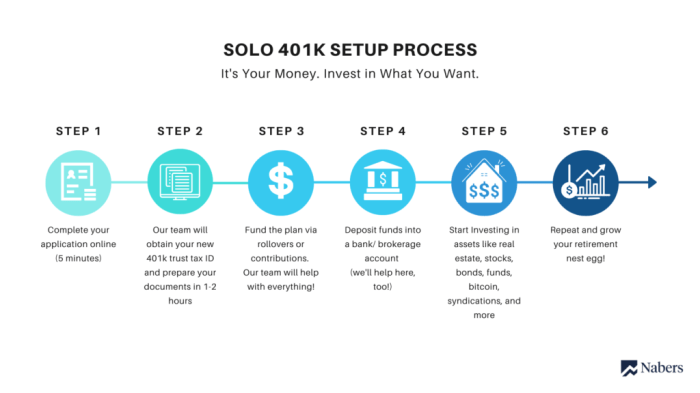
When it comes to investing through a Solo 401k, there are various options available that provide self-employed individuals with flexibility and control over their retirement savings.
Traditional Investments
- Stocks
- Bonds
- Mutual Funds
- Exchange-Traded Funds (ETFs)
Alternative Investments
- Real Estate
- Private Equity
- Cryptocurrency
- Precious Metals
Comparing Investment Flexibility
Unlike other retirement accounts like IRAs, Solo 401ks offer a wider range of investment options, including alternative investments like real estate and cryptocurrency. This flexibility allows self-employed individuals to diversify their retirement portfolio beyond traditional assets.
Potential Growth Opportunities
By leveraging the investment flexibility of a Solo 401k, self-employed investors can potentially capitalize on higher returns offered by alternative investments. These opportunities for growth can lead to enhanced retirement savings and greater financial security in the future.
Contribution Strategies

When it comes to maximizing contributions to a Solo 401k, there are a few key strategies that self-employed investors can utilize to make the most of this retirement account. One important aspect to consider is the distinction between elective deferrals and profit-sharing contributions.
Additionally, individuals who are over 50 years old may also take advantage of catch-up contributions to boost their retirement savings even further.
Differences between Elective Deferrals and Profit-Sharing Contributions
- Elective deferrals are contributions that you choose to make from your salary into your Solo 401k account. These contributions are typically deducted from your paycheck before taxes are taken out, allowing you to lower your taxable income.
- Profit-sharing contributions, on the other hand, are made by the employer (which, in the case of a self-employed individual, would be you as the business owner) based on a percentage of your business profits. These contributions are tax-deductible for the business.
Catch-Up Contributions for Individuals Over 50
- Individuals who are 50 years old or older are eligible to make additional catch-up contributions to their Solo 401k on top of the regular contribution limits. For the year 2021, the catch-up contribution limit is $6,500, allowing older investors to further boost their retirement savings.
- These catch-up contributions can provide a valuable opportunity for individuals nearing retirement age to accelerate their savings and make up for any lost time in building their retirement nest egg.
Tax Planning with Solo 401k
When it comes to tax planning with a Solo 401k, it is essential to understand the implications of contributions, investments, and withdrawals from this retirement account. By strategically utilizing a Solo 401k, self-employed individuals can significantly reduce their taxable income and enhance their overall financial health.
Tax Implications of Contributions
- Contributions made to a Solo 401k are tax-deductible, allowing self-employed individuals to lower their taxable income for the year.
- For 2021, the contribution limit for a Solo 401k is $58,000 or $64,500 for individuals over the age of 50, providing ample opportunity for substantial tax savings.
- By maximizing contributions to your Solo 401k, you can effectively reduce your current tax liability while saving for retirement.
Tax Implications of Investments
- With a Solo 401k, investment earnings grow tax-deferred, meaning you do not pay taxes on capital gains, dividends, or interest until funds are withdrawn.
- This tax-deferral feature allows your investments to compound over time without the drag of annual tax payments, enhancing your overall returns.
Tax Implications of Withdrawals
- Withdrawals from a Solo 401k are taxed as ordinary income, which can be advantageous if you are in a lower tax bracket during retirement.
- Additionally, Roth Solo 401k contributions can be withdrawn tax-free in retirement, providing tax diversification and flexibility in managing tax liabilities.
Tax Planning Strategies
- Consider making the maximum allowable contributions to your Solo 401k each year to reduce your taxable income and take advantage of tax-deferred growth.
- Utilize Roth contributions within your Solo 401k to create tax-free income streams in retirement, diversifying your tax liabilities.
- Regularly review your investment portfolio within your Solo 401k to ensure alignment with your tax planning goals and risk tolerance.
Last Word
Concluding our discussion on Solo 401k Strategies for Self-Employed Investors, it's evident that this retirement savings vehicle offers a myriad of benefits and opportunities for those venturing into self-employment. By implementing the right strategies and maximizing contributions, individuals can secure a financially stable future while minimizing tax burdens.
Dive into the world of Solo 401k with confidence and watch your investments grow with each passing year.
FAQ Corner
What are the eligibility criteria for setting up a Solo 401k?
To be eligible, you must be self-employed with no full-time employees other than a spouse working for the business.
What are the differences between elective deferrals and profit-sharing contributions?
Elective deferrals are contributions made by the employee, while profit-sharing contributions are made by the employer based on profits.
How do catch-up contributions work for individuals over 50 years old?
Individuals over 50 can make additional catch-up contributions to their Solo 401k above the regular contribution limits.