
Exploring the realm of tax benefits associated with Solo 401k Contributions opens up a world of financial possibilities for individuals looking to secure their future. The ability to minimize tax liabilities while saving for retirement is a powerful tool that can ultimately lead to greater financial security and independence.
As we delve deeper into the nuances of Solo 401k contributions, we uncover a treasure trove of strategies and insights that can help you make the most of your retirement savings.
As we navigate through the various facets of tax advantages and contribution limits, you will gain a comprehensive understanding of how Solo 401k contributions can be a game-changer in your financial planning journey.
Understanding Solo 401k Contributions
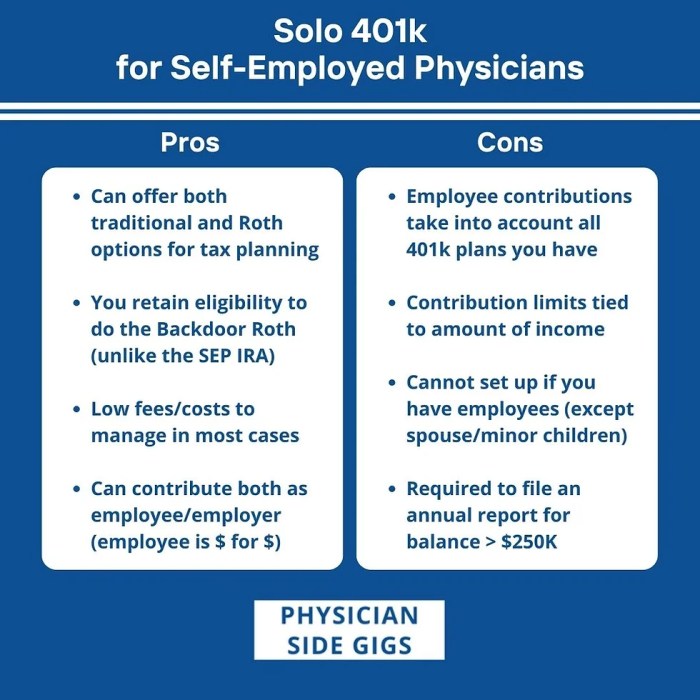
Solo 401k contributions refer to the contributions made by self-employed individuals or small business owners to their retirement accounts. These contributions can provide tax benefits and help individuals save for their future.
Differences from Other Retirement Plans
Solo 401k contributions differ from other retirement plans in several ways. Unlike traditional 401(k) plans, Solo 401k plans are designed for self-employed individuals or small business owners with no full-time employees other than a spouse. This unique feature allows for higher contribution limits and greater flexibility in investment options.
Eligibility Criteria
- To be eligible to contribute to a Solo 401k, individuals must be self-employed with no full-time employees other than a spouse.
- The business must generate income through self-employment activities such as consulting, freelancing, or running a small business.
- Contributions to a Solo 401k are based on a percentage of the individual's self-employment income, up to a certain limit set by the IRS.
Tax Advantages of Solo 401k Contributions
Contributing to a Solo 401k comes with several tax benefits that can help you save money in the long run. By understanding how these contributions impact your taxable income, you can make informed decisions about your retirement planning.
Reducing Taxable Income
When you contribute to a Solo 401k, the amount you contribute is deducted from your taxable income for that year. This means that if you contribute $10,000 to your Solo 401k, your taxable income will be reduced by $10,000. As a result, you will owe less in taxes for that year, potentially putting you in a lower tax bracket and saving you money.
- Contributions to a Solo 401k can lower your tax bill for the current year by reducing your taxable income.
- These contributions grow tax-deferred until you withdraw the funds in retirement, allowing your investments to compound without being taxed annually.
- By strategically contributing to your Solo 401k, you can maximize your tax savings while building your retirement nest egg.
Comparison to Other Retirement Plans
Solo 401k contributions offer unique advantages compared to other retirement plans, such as SEP IRAs or Traditional IRAs. While these plans also provide tax benefits, Solo 401k contributions allow for higher contribution limits and the ability to make both employer and employee contributions, maximizing your tax savings potential.
It's essential to consider the tax advantages of Solo 401k contributions when planning for your retirement to optimize your savings and minimize your tax liability.
Contribution Limits and Tax Deductions
When it comes to Solo 401k plans, understanding the contribution limits and tax deductions is crucial for maximizing the benefits of this retirement account.
For Solo 401k plans, the contribution limits are typically higher compared to other retirement accounts. As of 2021, self-employed individuals can contribute up to $19,500 as an employee, plus an additional 25% of their net self-employment income as an employer, with a total combined limit of $58,000 (or $64,500 for those aged 50 and older).
How Tax Deductions Work
- Contributions made to a Solo 401k are tax-deductible, meaning that the amount contributed reduces your taxable income for the year.
- As a self-employed individual, you can benefit from a lower tax bill by taking advantage of the tax deductions associated with your Solo 401k contributions.
- These tax deductions can help you save money on taxes while simultaneously building your retirement savings for the future.
Examples of Tax Deductions Benefits
- Scenario 1:If you are self-employed and contribute $10,000 to your Solo 401k, you can deduct this amount from your taxable income. For instance, if your taxable income is $80,000, deducting the $10,000 contribution would reduce it to $70,000, resulting in lower taxes owed.
- Scenario 2:For those aged 50 and older, making catch-up contributions can further enhance tax deductions. If you contribute the maximum limit of $64,500, you can significantly reduce your taxable income, leading to substantial tax savings.
Roth Solo 401k Contributions
When it comes to Solo 401k contributions, individuals also have the option to make Roth contributions. Unlike traditional contributions, Roth contributions are made with after-tax dollars.
Tax Implications of Roth Solo 401k Contributions
With Roth Solo 401k contributions, withdrawals in retirement are tax-free, including both the contributions and any investment earnings. This can be advantageous for individuals who anticipate being in a higher tax bracket during retirement.
Differences Between Traditional and Roth Solo 401k Contributions
- Roth contributions are made with after-tax dollars, while traditional contributions are made with pre-tax dollars.
- Traditional contributions offer an immediate tax break since they lower taxable income for the current year, while Roth contributions do not provide an upfront tax benefit.
- Withdrawals from traditional Solo 401k contributions are taxed as ordinary income in retirement, whereas withdrawals from Roth contributions are tax-free.
- Roth contributions may be beneficial for those who expect their tax rate to be higher in retirement, as they can lock in current tax rates and enjoy tax-free withdrawals later on.
Ultimate Conclusion
In conclusion, the tax benefits of Solo 401k contributions offer a unique opportunity for individuals to optimize their retirement savings while minimizing tax burdens. By taking advantage of the tax advantages and contribution limits Artikeld in this discussion, you can pave the way for a more secure and prosperous financial future.
Make the most of your Solo 401k contributions and embark on a journey towards a financially stable retirement.
Essential FAQs
What are the eligibility criteria for contributing to a Solo 401k?
To contribute to a Solo 401k, you must be self-employed or a business owner with no full-time employees other than a spouse.
Can Solo 401k contributions reduce taxable income?
Yes, contributions to a Solo 401k can reduce your taxable income, potentially lowering your overall tax liability.
What are the contribution limits for Solo 401k plans?
For 2021, the contribution limits for Solo 401k plans are $58,000 for individuals under 50 and $64,500 for those 50 and older.
Are Roth contributions an option for Solo 401k plans?
Yes, Solo 401k plans offer the option of making Roth contributions, which can provide tax-free withdrawals in retirement.
How do tax deductions work with Solo 401k contributions?
Contributions to a Solo 401k are typically tax-deductible, meaning you can reduce your taxable income by the amount you contribute.